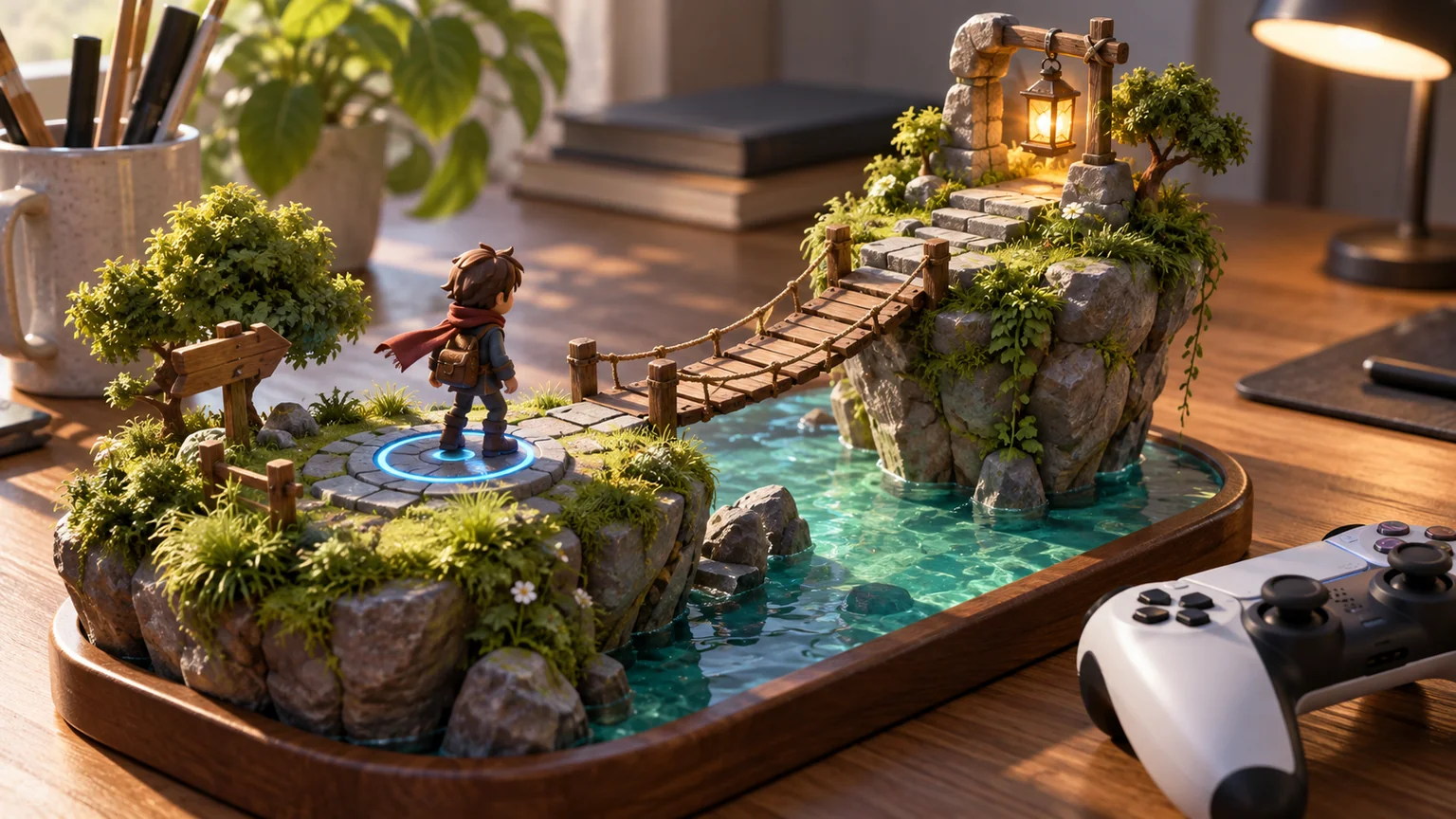
A game can contain excellent generated art and still be unpleasant to play. An AI tool may accelerate one stage while adding cleanup, inconsistency, or unpredictable behavior to another.
A small playable slice is a better evaluation environment than a gallery of isolated outputs.
Define the slice
Choose one short experience with a clear player objective, a small environment, a few interactions, and an ending.
Write constraints for visual style, controls, performance, and content. Keep the scope small enough that a human can inspect the entire path.
This slice gives every tool the same question: does its output help deliver this experience?
Keep generated assets coherent
Use a shared brief for scale, perspective, palette, surface detail, and silhouette. Inspect assets together, not only one at a time.
A character that looks good alone may not fit the environment’s proportions. A texture can be detailed yet visually noisy at gameplay distance.
Track reference rights, generation settings, and processing steps so a useful output can be revised or replaced.
Use code assistance with observable contracts
Ask for behavior that can be exercised: the player can pick up an item, the item persists after a scene transition, and an invalid interaction leaves the state unchanged.
Review the implementation against those behaviors. A large volume of generated code is not evidence of progress if the slice becomes harder to debug.
Keep dependencies and engine versions explicit. Generated calls need verification against the actual project’s API.
Give automated playtesting a narrow job
An automated agent can repeat routes, search for stuck states, or stress a mechanic. It may miss frustration, confusing feedback, or an uninteresting decision.
Combine repeatable machine checks with human play. Record what the automated policy can observe and what actions it can take.
A test that finishes the level by exploiting an unintended shortcut is a useful finding, not necessarily a successful quality score.
Separate online AI from authored content
Generating dialogue during play introduces latency, cost, content constraints, and failure modes. Pre-generated and reviewed dialogue has a different tradeoff.
Choose the approach for the experience, not because one seems more advanced. A game should remain coherent when a model request fails.
Keep important mechanics and world rules in deterministic systems. The language model can propose flavor or intentions within those boundaries.
Treat agent play as another test instrument
DeepMind’s SIMA 2 announcement presents a research agent operating in virtual worlds through visual observations and keyboard or mouse actions. The announcement describes limited research access and acknowledges difficulties with long tasks and precise control. It is evidence of a research direction, not a ready-made production NPC or universal playtester.
For an accessible local test harness, begin with explicit goals such as reaching an exit, completing a crafting recipe, or recovering after a failed jump. Record the initial save, allowed actions, time limit, and authoritative completion condition. Let exploratory agents discover candidate problems, then turn confirmed problems into repeatable fixtures.
An agent reporting “I finished” is insufficient if the level’s completion flag never changed.
Evaluate the integrated game, not merged work
Anthropic’s August 2026 multi-agent study includes game-building experiments where active coordination and many code changes did not reliably produce a coherent product. Its lesson for a small team is to keep the playable result visible throughout integration.
After each significant change, replay the slice from a fresh start: understand the objective, perform the central action, encounter failure, recover, and reach the ending. Record broken transitions and confusing feedback alongside technical faults.
Ask a human unfamiliar with the implementation to play without coaching. Automated success can coexist with poor pacing or unreadable controls. Count the slice as ready when its technical checks pass and a person can understand and enjoy the intended loop. The production method remains a combination of instrumentation, authored judgment, and direct play.
Count the complete production cost
Include prompting, rejected generations, cleanup, integration, performance work, and review. Measure accepted results in the playable slice.
The aim is a repeatable way to make a better game. A tool earns its place when it improves that process without making the player absorb its limitations.
Keep a good idea close.
Follow Signal Tower