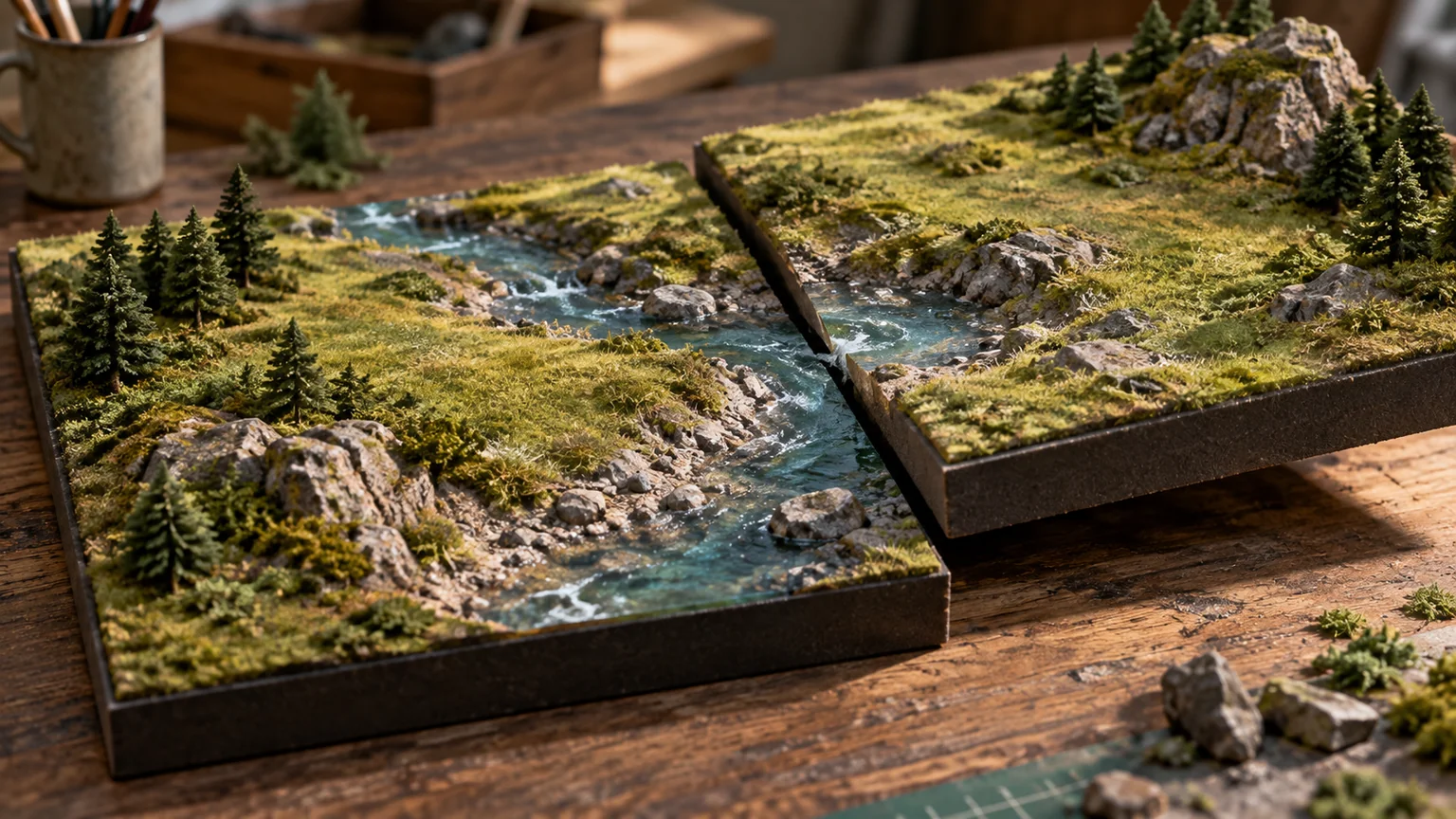
A model becomes useful to a physical operation when someone can explain how it relates to the real system. What is measured? What is estimated? How old is the state? What would reveal that the model is wrong?
Those questions matter more than whether the dashboard is called a digital twin.
State the intended decision
A visualization for training, a maintenance forecast, and a control system need different levels of fidelity and assurance.
Write the decision first. For a robotic assembly station, you might want to compare reach, inspect a proposed sequence, or test a policy in simulation. None of those alone establishes that the machine may execute the sequence safely.
Keep advisory outputs separate from commands that affect hardware.
Build a traceable physical model
Record geometry, units, joints, limits, masses, contact assumptions, sensors, and actuators. Identify measured parameters and estimates.
The MuJoCo overview describes a physics engine’s modeling and simulation scope. Selecting an engine does not validate the particular model built inside it.
A realistic rendering can hide an incorrect center of mass or joint axis. Inspect the numerical model as well as the image.
Compare against known behavior
Choose simple physical cases whose outcomes can be measured. Compare position, timing, force where appropriately instrumented, and failure behavior.
Vary one assumption at a time when diagnosing disagreement. A complex learned controller can compensate for one model error while making the system harder to understand.
Record the range over which the comparison supports the model. Agreement in one slow motion does not establish accuracy under every load and speed.
Treat sim-to-real as an experiment
Domain randomization and related methods can expose a policy to variation. They do not make every real-world condition part of the training distribution.
Document which parameters vary, how the ranges were chosen, and what remains outside them. Keep held-out scenarios and test transfer progressively under qualified supervision.
The recovered draft’s universal cost ratios and sweeping claims about autonomous construction are not evidence of such a validation program.
Keep live state interpretable
If a twin receives sensor data, track timestamps, units, calibration, missing values, and confidence. A stale but smooth animation can be more misleading than a visible unavailable state.
Define what happens when signals disagree or a connection fails. The model should not continue to present an estimate as a fresh measurement.
Choose a solver for the validation question
NVIDIA’s current Newton physics documentation describes an open simulation engine built on Warp, with OpenUSD integration and a MuJoCo Warp solver among its components. That broadens the tooling available for robotics and physical simulation. It does not make an imported scene a validated twin.
Choose the smallest model that can answer the intended decision: clearance, timing, contact response, or control behavior. Record which solver and settings generated each result. Comparing two solvers can reveal sensitivity to numerical choices, but agreement between them is not independent physical evidence.
For impact behavior, research such as Validating Robotics Simulators on Real-World Impacts illustrates the value of comparing simulator predictions with measured events. The physical test and its measurement uncertainty remain central even as engines improve.
Keep calibration data out of the final test
Create three groups of physical observations: measurements used to build the model, trials used to calibrate uncertain parameters, and held-out trials used to assess the calibrated result. Do not tune friction on a trial and then report that same trial as independent validation.
Define errors in the units of the decision. For a moving assembly, these might be position error over time, contact timing, peak displacement, and whether the system settles into the correct state. Report the range of conditions tested and the conditions where the model fails.
Vary uncertain parameters across justified bounds and inspect whether the decision changes. If small plausible changes reverse the recommendation, the output should expose that sensitivity. A more detailed simulation is useful only when its evidence supports the question being asked.
Deliver evidence with the model
Package the model version, parameter sources, validation cases, residual errors, and operating limits. A future engineer should be able to understand what changed.
Digital twins are valuable when they shorten the path between an observation and a useful decision. Their credibility comes from that loop, not from the complexity of the visualization.
Keep a good idea close.
Follow Signal Tower