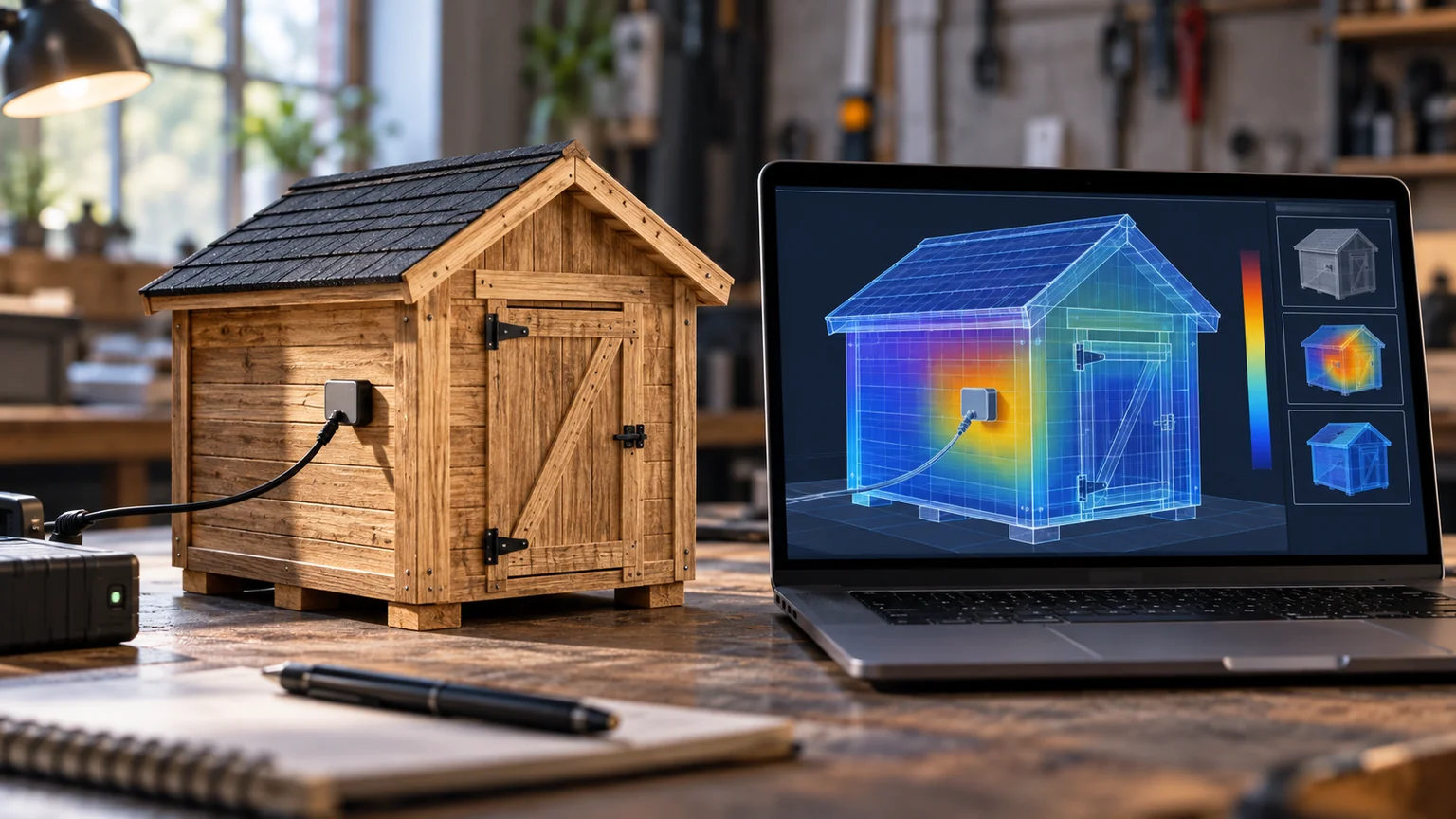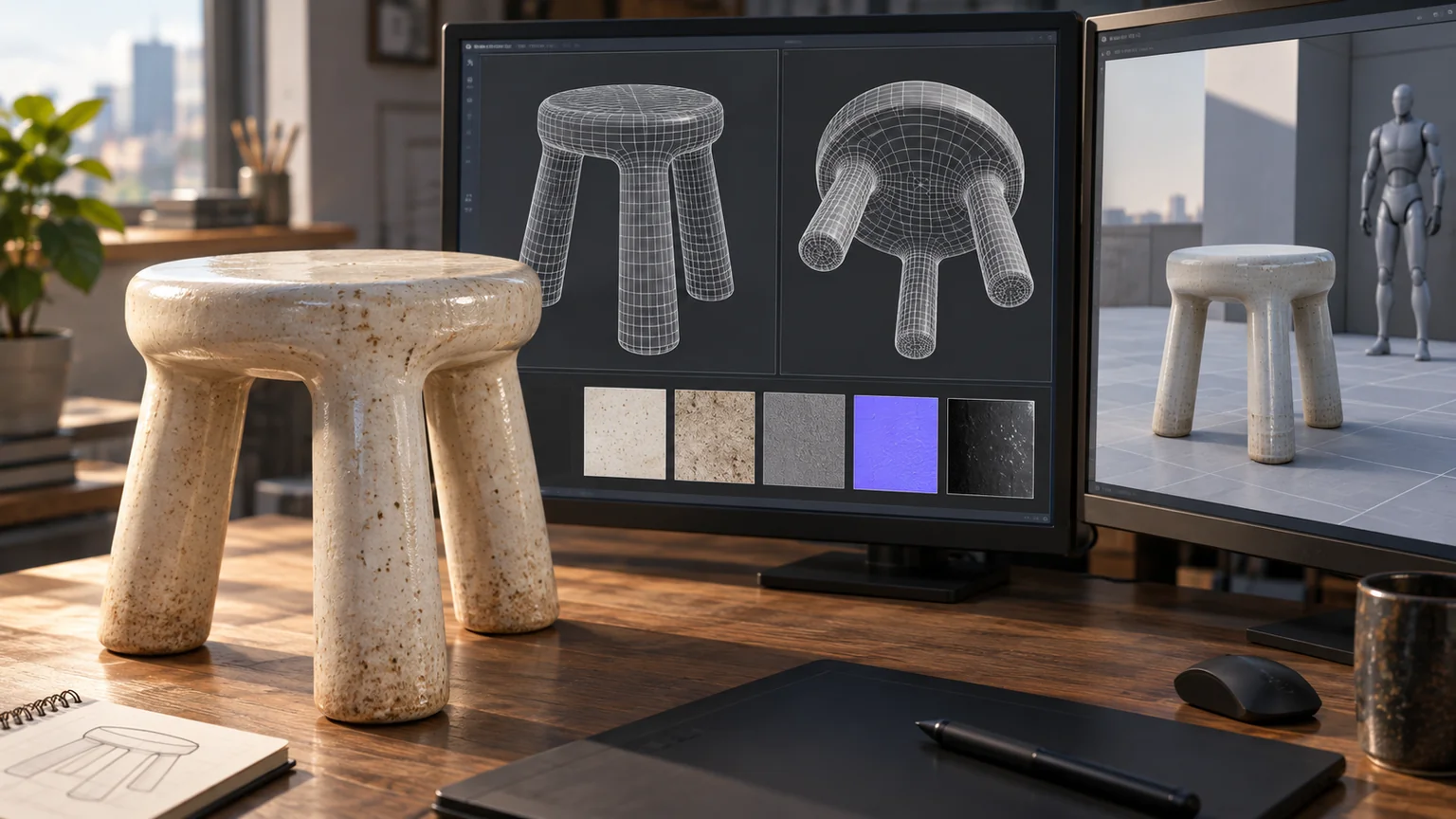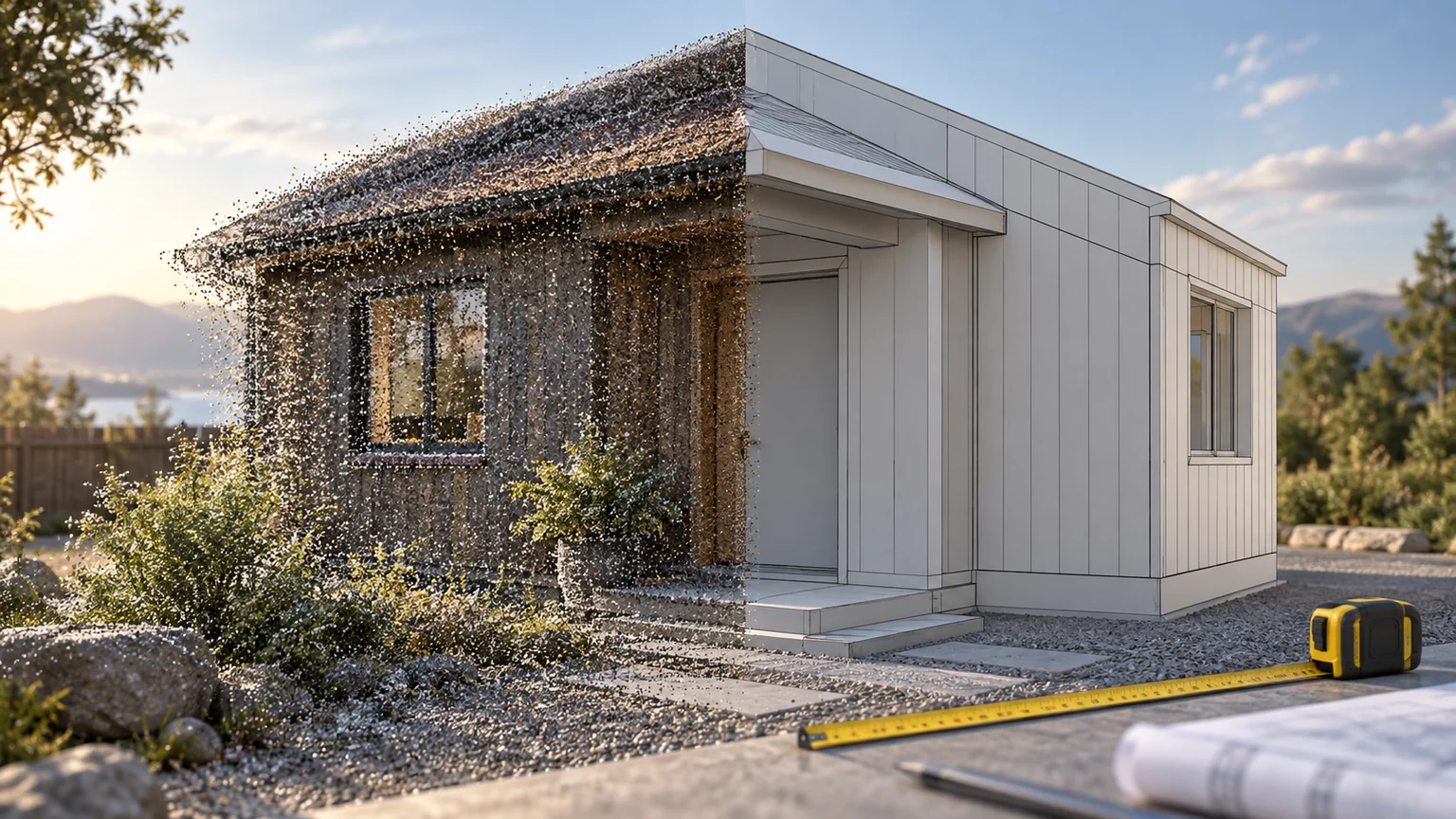
A reconstructed scene can feel remarkably present. Move the camera and the light, texture, and small irregularities of a real place appear to move with it.
That experience is useful. It does not automatically provide an editable architectural model.
Separate appearance from structure
Radiance-field methods represent how a scene appears from different views. A CAD model represents surfaces, dimensions, and relationships in a form intended for design work.
The original 3D Gaussian Splatting research demonstrates a representation and renderer for novel-view synthesis using optimized 3D Gaussians. Its contribution should not be confused with a guarantee of measured geometry or structural semantics.
A captured wall can look convincing without being a clean plane with an authoritative thickness.
What recent reconstruction work adds
The May 2026 2D-SuGaR paper uses depth and normal priors to improve Gaussian initialization and surface reconstruction, with evaluation on DTU. It shows why the broad claim that splats can never support mesh recovery is too strong. Recovered surfaces still need validation for the decision being made. 2D-SuGaR.
NVIDIA’s 3DGRUT repository records a June 2026 release adding Neural Harmonic Textures, alongside its Gaussian ray-tracing and rasterization paths. These are appearance and rendering developments, not automatic recovery of wall assemblies, design constraints, or land-survey accuracy. 3DGRUT project and release history.
Choose the reconstruction path by the intended deliverable: a viewable capture, a relightable scene, an extracted surface, or an editable design. Keep those deliverables separately named in the asset manifest.
Validate views and dimensions independently
Hold back some camera views from reconstruction and inspect the result from those viewpoints. Score appearance defects separately from measured geometric errors. A good image similarity result can coexist with a bent plane or an opening whose width is wrong.
For a building overlay, record the transform between capture coordinates and design coordinates, the measured control points used to estimate it, and residuals at independent check points. Retain the capture date and any moving objects excluded from reconstruction. An inferred depth prior should be recorded as an inference even when it improves visual quality.
My suggested handoff has three independently replaceable assets: the appearance capture, the measured or parametric design, and the collision or interaction proxy. Test selection and clearance against the authoritative model. This lets newer reconstruction methods improve the scene without silently changing what the application promises about dimensions.
Capture for the intended movement
Plan where the viewer will go. Coverage, lighting consistency, reflective surfaces, moving objects, and occlusions affect reconstruction quality.
A scene captured mostly from one side may fail when the viewer walks behind it. A chair or window can contain missing or unstable regions that a front-facing demo never reveals.
Keep the capture conditions and known gaps with the result.
Establish scale separately
If dimensions matter, introduce an appropriate scale reference and validate against measurements. Do not estimate a route clearance or a foundation size solely from an attractive reconstruction.
A building configurator can overlay a model into a captured context, but the placement needs a coordinate relationship and a clear statement of accuracy.
Visual alignment and surveyed alignment are different claims.
Budget delivery and interaction
Splat data can be substantial. Test first useful view, memory, sorting or rendering cost, and movement on the intended devices.
A web renderer may use a different optimization path from the research implementation. Report the application actually tested rather than transferring a paper’s performance figure to the browser.
Provide a simpler fallback when the full reconstruction is too expensive.
Plan editing and maintenance
Decide what happens when the real place changes. A captured delivery route may no longer reflect a new fence or parked equipment.
Version the capture and show its date where that matters. Keep configuration objects independently editable rather than baking every product choice into a capture.
If the application needs collision, measurements, or semantic selection, build those representations deliberately and validate their relationship to the visual scene.
Use the right representation together
A practical system can combine a captured context, a parametric building, and a simplified interaction model. Each solves a different problem.
The strongest result is not the one that pretends a single representation does everything. It is the one that makes the scene convincing while preserving the authority of the measurements and design decisions.
Keep a good idea close.
Follow Signal Tower