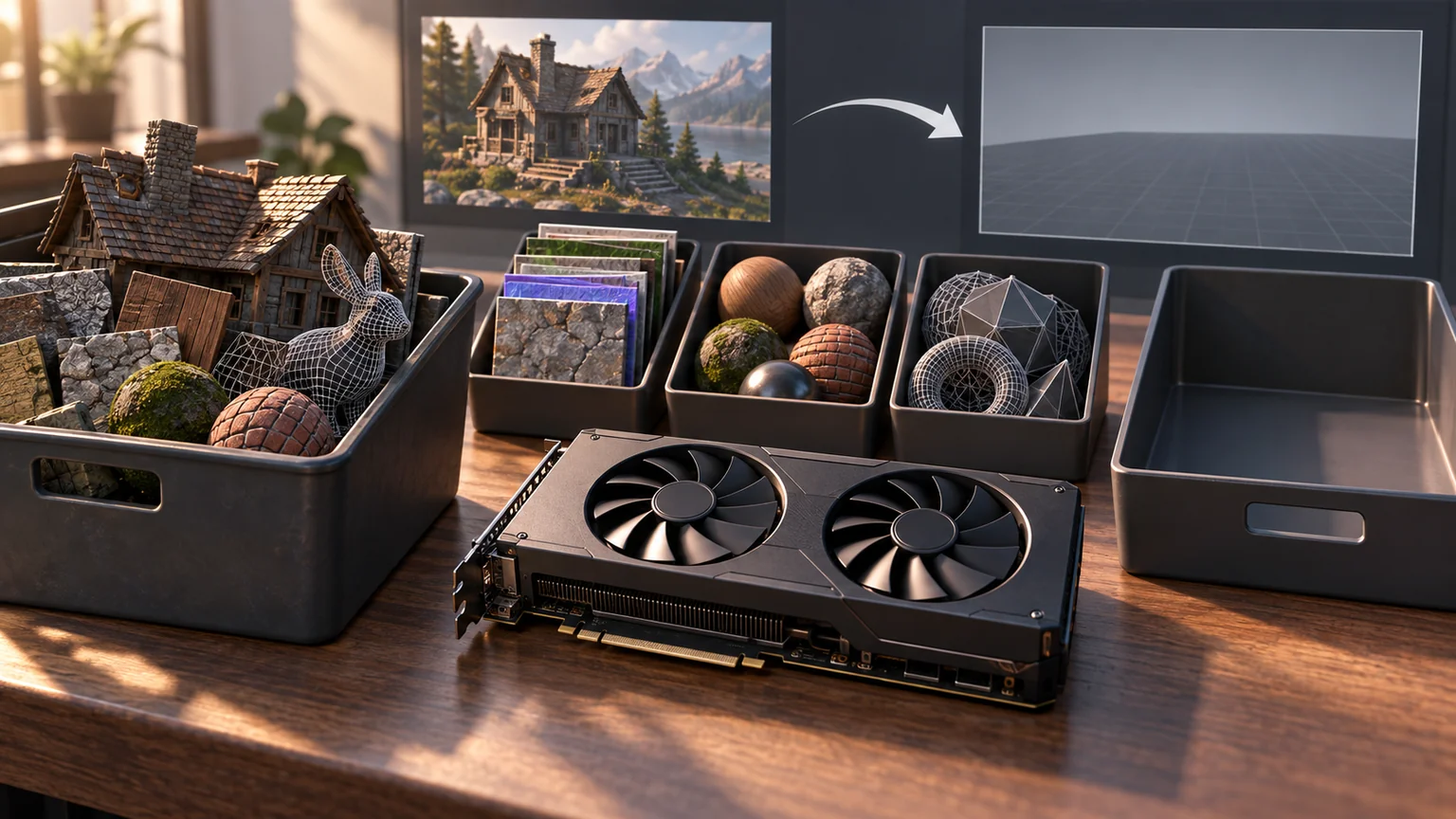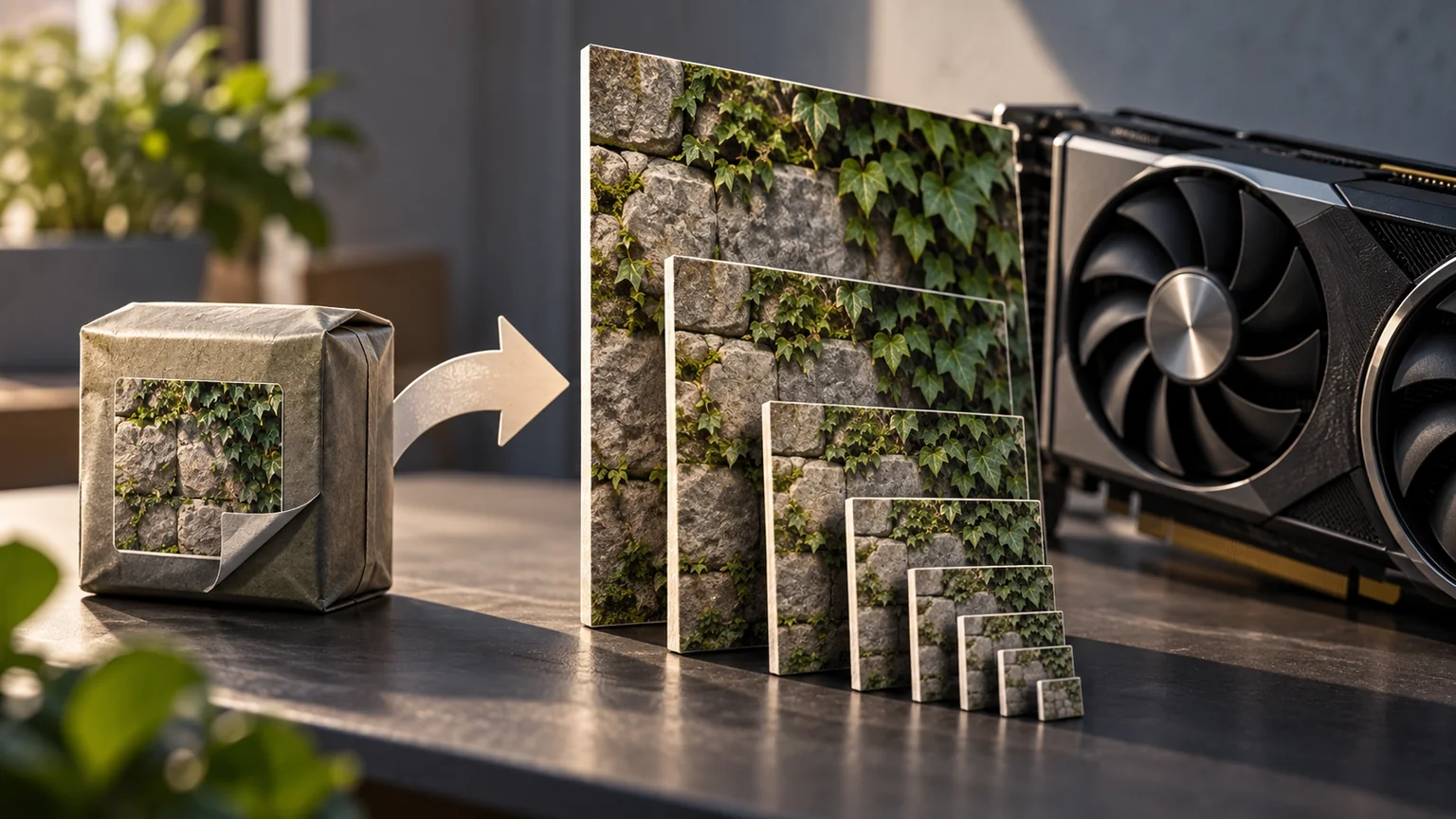
An 8K texture is a large allocation before it is a visual achievement. Start by asking how many of its texels the user will actually see.
The recovered texture research made 8K sound like a new minimum standard. It is better understood as one possible source resolution, useful for some close views and expensive when used indiscriminately.
Do the uncompressed arithmetic
An 8,192-square image contains 67,108,864 texels. At four bytes per texel, one RGBA8 base level occupies 256 MiB. A complete mip chain is approximately 341.33 MiB.
Those figures describe pixel storage for that format. They do not include every driver allocation, decoding buffer, render target, or additional material map.
A five-map material can therefore become expensive quickly. Not every map needs four channels or the same resolution. Decide those requirements separately.
Separate delivery from allocation
KTX2 describes a container. It can carry different kinds of texture data and mip levels. Basis Universal encoding and the runtime transcode target add further choices.
The Khronos KTX specification defines the format and its metadata. A filename ending in KTX2 does not promise one fixed compression ratio or one GPU allocation size.
Inspect the actual target format, block dimensions, and level count. Compare download size, decode or transcode time, upload behavior, and retained allocation as separate measurements.
Choose quality by channel
A color map may tolerate compression artifacts that are distracting in a normal map. A roughness map can reveal banding under a moving highlight even when it looks harmless in an image viewer.
Test materials under the lighting and camera motion used by the product. Inspect seams, repeated tiles, grazing reflections, and small high-contrast details.
Keep a reference material and compare candidate encodings at the same scale. A smaller file is only an improvement if the important surface information survives.
Calculate the selected block format
For a block-compressed level, estimate storage as the number of blocks across multiplied by the number of blocks down and the bytes per block. Round partial edge blocks upward; repeat the calculation for every mip level. Arrays, faces, depth, and separate maps add their own multipliers. This is format arithmetic, not a measurement of the driver’s total allocation.
For example, a 4096-square BC7 level uses 4 × 4 blocks of 16 bytes: 16 MiB for the base level, compared with 64 MiB for RGBA8. The example is useful only if BC7 is the selected runtime format. A device using another target needs another calculation. KTX format and level definitions.
Pin the loader and transcoder together
Three.js’s current KTX2Loader documents support detection for the renderer and marks detectSupportAsync() as deprecated. Check the API shipped in your pinned Three.js release before copying an older WebGPU setup. Keep the loader, transcoder JavaScript, and WASM files from a compatible version. KTX2Loader API.
My suggested comparison matrix has one row per material and target: source hash, encoding settings, runtime block format, mip count, transfer size, transcode duration, estimated allocation, and visual verdict. Include a deliberately unsupported path to confirm that the fallback asset loads.
Start with a painted panel, a fine normal map, and a roughness gradient. Compare moving highlights after encoding; inspecting the compressed file as a flat image is insufficient. During an upgrade, account for the period when old and replacement textures coexist. The smallest download can still be the wrong choice if decoding stalls interaction or the material loses its defining surface detail.
Deliver the useful level first
A distant building does not need the same texture detail as a close inspection of its siding. Use asset variants or a deliberate streaming strategy.
Streaming is not free: it introduces loading state, replacement logic, cache ownership, and possible temporary overlap between old and new allocations. Make those transitions part of the budget.
A low-resolution fallback should preserve the correct material identity and color relationship while detail arrives.
Avoid the repetition trap
Higher resolution does not remove visible tiling. Grain direction, tile scale, and repeated distinctive marks can reveal the pattern across a large wall.
Use suitable source material and controlled variation. Preserve the intended physical scale; randomizing a wood texture until it looks “natural” can make boards disagree about their grain.
The memory lab is a useful first estimate. The final decision belongs to a material comparison on the actual application and device.
Resolution is an input. A convincing, stable material is the result.
Keep a good idea close.
Follow Signal Tower